
DeepSeek shipped an update to V4.1 Flash on October 17. It carries the date in its name: 1017. Independent evaluations put it near the top, and it is cheap.
The interesting part is not the score, though. It is that the model files are fully public. That is why many companies sell the same model, and where and when you use it can change the price by up to 10x. This post covers five things:
- What changed in 1017
- What "open weight" means and why it matters
- How to use it cheaply, or for free
- A quick run with DeepSeek's own coding agent
- Our own head-to-head against the previous version
How to read the numbers. Each number is tagged with its source. [Self-reported] means DeepSeek or the vendor published it, [Independent] means a third-party evaluator measured it, [Our measurement] means we ran it ourselves, and [Community report] means an individual user's post (not reproduced).
1. What changed in 1017
1017 is not a new model. The architecture is unchanged; it is a re-run of post-training, and it is already live on DeepSeek's website, app and API (DeepSeek announcement).
- Scores: in DeepSeek's table every item improved over the previous version. Terminal-Bench 4.0 jumped from 31.2 to 42.3. [Self-reported] (model card)
- Measured by someone else: Vals AI re-ran the same benchmark and got 31.82. Vendor numbers and third-party numbers can differ this much, because the harness and settings differ. [Independent]
- Overall: Artificial Analysis gives it an Intelligence Index of 45, 2nd out of 121 models in its comparison group, at about $0.26 per evaluation task. [Independent] (Artificial Analysis)
- Shorter answers: DeepSeek says the model thinks less verbosely, cutting the cost of one coding task from about $0.50 to about $0.20. [Self-reported] (The Decoder)
2. What "open weight" means and why it matters
An AI model is ultimately a huge bundle of numbers called weights. Claude and GPT keep their weights on the vendor's servers; we send requests there and effectively rent the model. An open-weight model publishes the weight files themselves. Anyone can download them, run them on their own hardware, modify them and redistribute them.
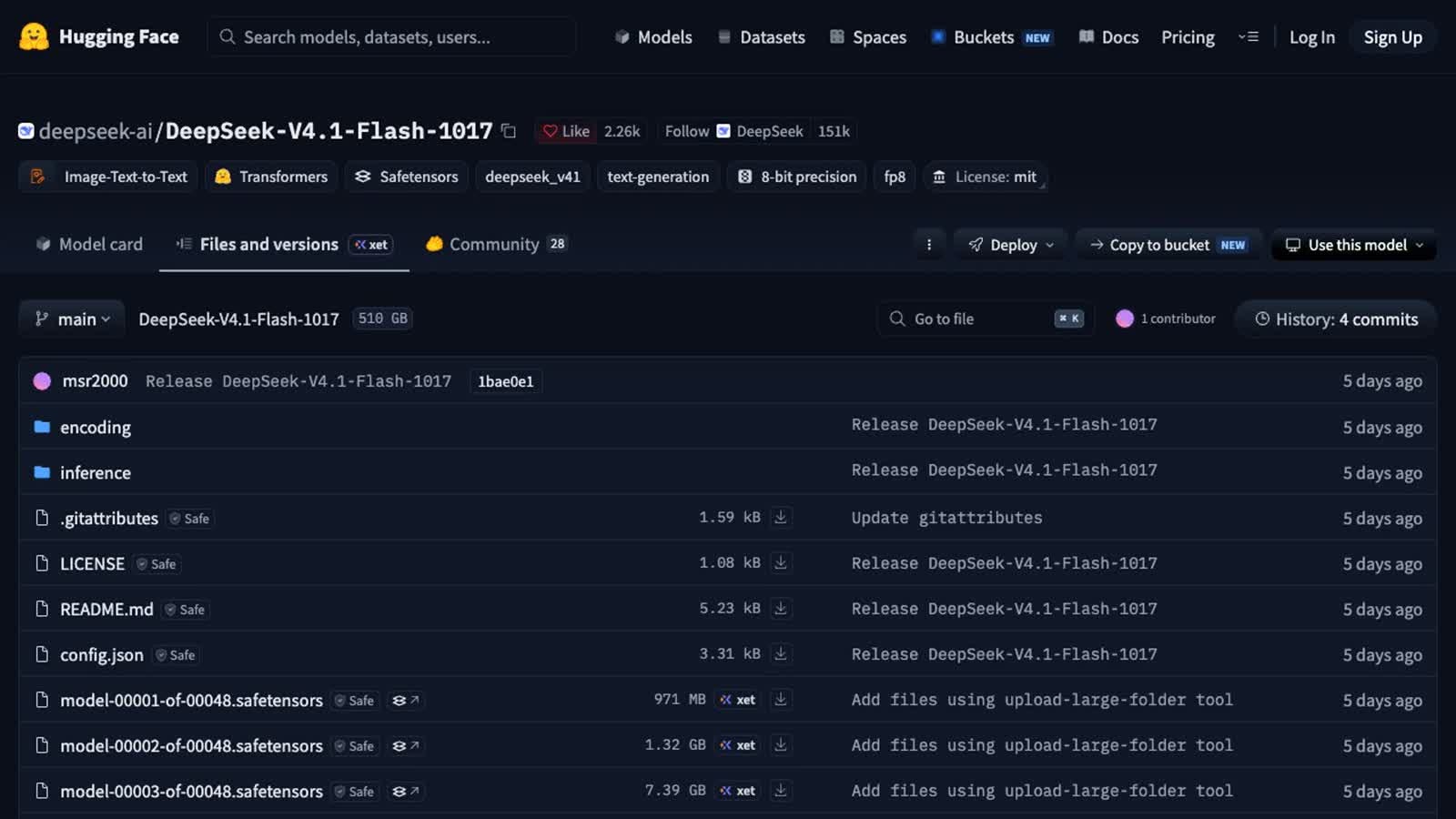
- Hugging Face hosts 83 files totaling about 510 GB. The total parameter count (the number of weights) is about 763.2 billion. (Hugging Face)
- The license is MIT: you may modify, sell and redistribute it, as long as you keep the copyright and license notice. (MIT License)
- But the training data and training code are not published. The Open Source AI Definition (OSAID 1.0) requires those too, so "open weight" is more accurate than "open source". (OSI definition)
Once the files are public, three things happen.
① Many companies sell the same model
On OpenRouter (a marketplace that routes one API to many model providers), 1017 is offered by 29 endpoints from about 25 providers (checked October 22). Prices are per 1 million tokens; a token is the unit a model reads and writes in, roughly a piece of a word.
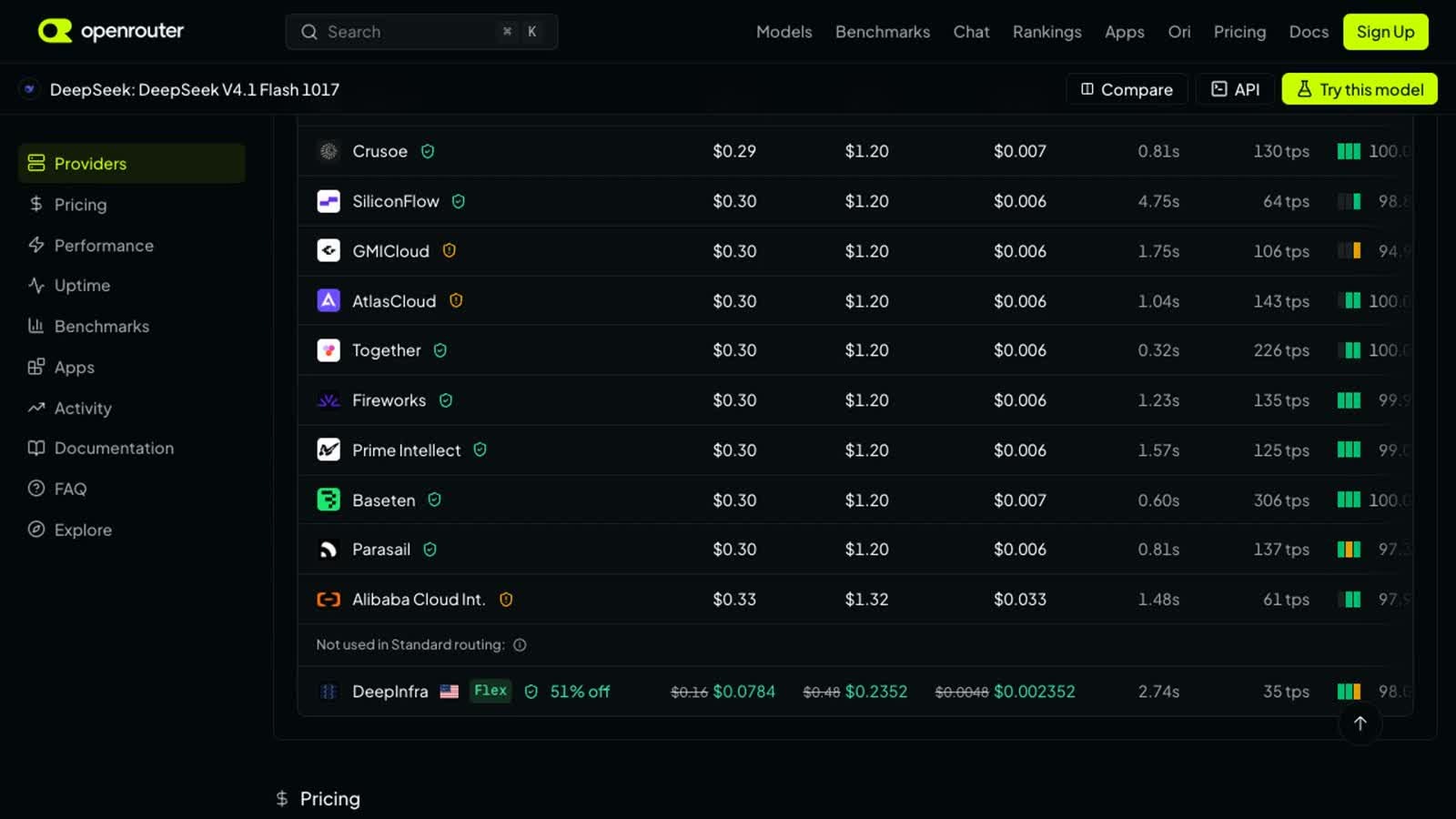
| Provider | Quantization | Input | Output |
|---|---|---|---|
| OpenInference | fp4 | $0.07 | $0.50 |
| Sail Research | fp4 | $0.101 | $0.15 |
| DeepSeek (original) | undisclosed | $0.15 | $0.60 |
| Together · Fireworks · Baseten, etc. | fp8 or undisclosed | $0.30 | $1.20 |
| Alibaba | undisclosed | $0.33 | $1.32 |
For the same model, input prices differ about 5x and output prices about 9x (OpenRouter API). Quantization stores the weights with fewer bits (fp8 → fp4 is smaller and faster but can lose some quality). Providers quantize differently, and we found no public data comparing accuracy across providers.
Speed differs too. Artificial Analysis measured the September version (before 1017) per provider: the fastest delivered 1,052 tokens per second and the slowest 67, about a 15x gap. [Independent] (provider comparison)
We saw this ourselves. Running five browser tasks three times each per model (section 5), the cost of one 1017 run swung from $0.003 to $0.011, three to four times, because OpenRouter routed each run to a different provider. [Our measurement]
② Someone tunes it to run faster and sells that
OpenGateway, run by a Korean company, tunes the same DeepSeek model for its own GPUs and sells it as deepseek-v4.1-flash-ultrafast, claiming 848 tokens per second. [Self-reported]
Read that number carefully:
- It was measured on September 18, 2026, before the 1017 update, on their own serving with a single concurrent request.
- This variant skips the reasoning pass and answers directly — that is why it is fast. The vendor itself recommends the original model for step-by-step work like math and proofs.
③ Companies run it on their own servers
On a community forum, a 40-person company (10 developers) described running the previous generation, DeepSeek V4 Flash, on a server with four RTX 6000 Blackwell MaxQ GPUs (about €55,000) as an internal chat assistant, for meeting notes and as a developer API. The main benefit: company data never leaves the building. [Community report] (r/LocalLLaMA)
The community moved fast. Within five days of release, 99 quantized variants and 23 fine-tuned variants of 1017 appeared, and NVIDIA published its own NVFP4 quantization. (Hugging Face model tree · NVIDIA NVFP4)
Can you run it at home?
- Running the original requires at least 614 GB of GPU memory (vLLM official recipe) — datacenter hardware. (vLLM recipe)
- Even quantized, you need 128–145 GB at 1-bit and about 305 GB at 4-bit. (Unsloth docs)
- People running reduced versions on home machines report 3–27 tokens per second, far from the 200+ tokens per second of hosted APIs. [Community report] (r/LocalLLaMA)
Our Mac has 36 GB of memory, so we did not try.
A caveat: your data stays home, but the model's leanings come along
If you self-host or use another company's server, your data does not go to DeepSeek. But in September 2025, NIST's CAISI found that an earlier DeepSeek model (V3.1) downloaded from Hugging Face still echoed Chinese government narratives, concluding that the censorship is in the weights (NIST). We found no CAISI evaluation of 1017 yet, but one personal test reports V4.1 Flash running on a US company's servers (Fireworks AI) still refused a question about Tiananmen 1989. [Community report] (post)
3. How to use it cheaply, or for free
Time-of-day pricing ① DeepSeek's official API — half price outside peak hours
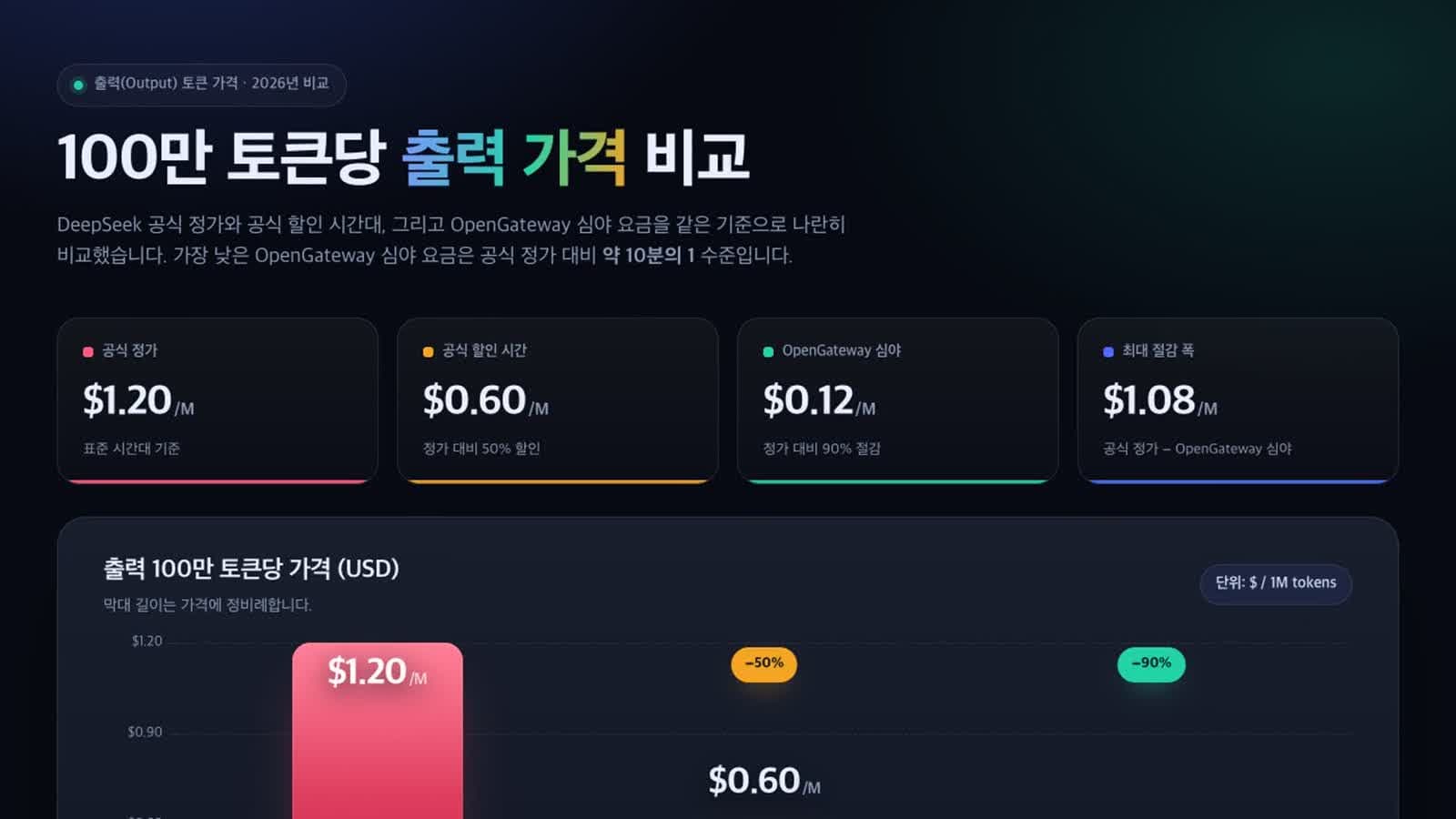
DeepSeek's official API charges by time of day (official pricing):
| Time | Input (cache miss) | Output |
|---|---|---|
| Peak: 01:00–04:00 and 06:00–10:00 UTC, Mon–Fri | $0.30 | $1.20 |
| All other times, including weekends | $0.15 | $0.60 |
(Peak hours exclude Chinese public holidays. In Korea time that is weekdays 10:00–13:00 and 15:00–19:00.) Batch big jobs outside those windows and you pay half.
Time-of-day pricing ② OpenGateway — up to 90% off until October 31
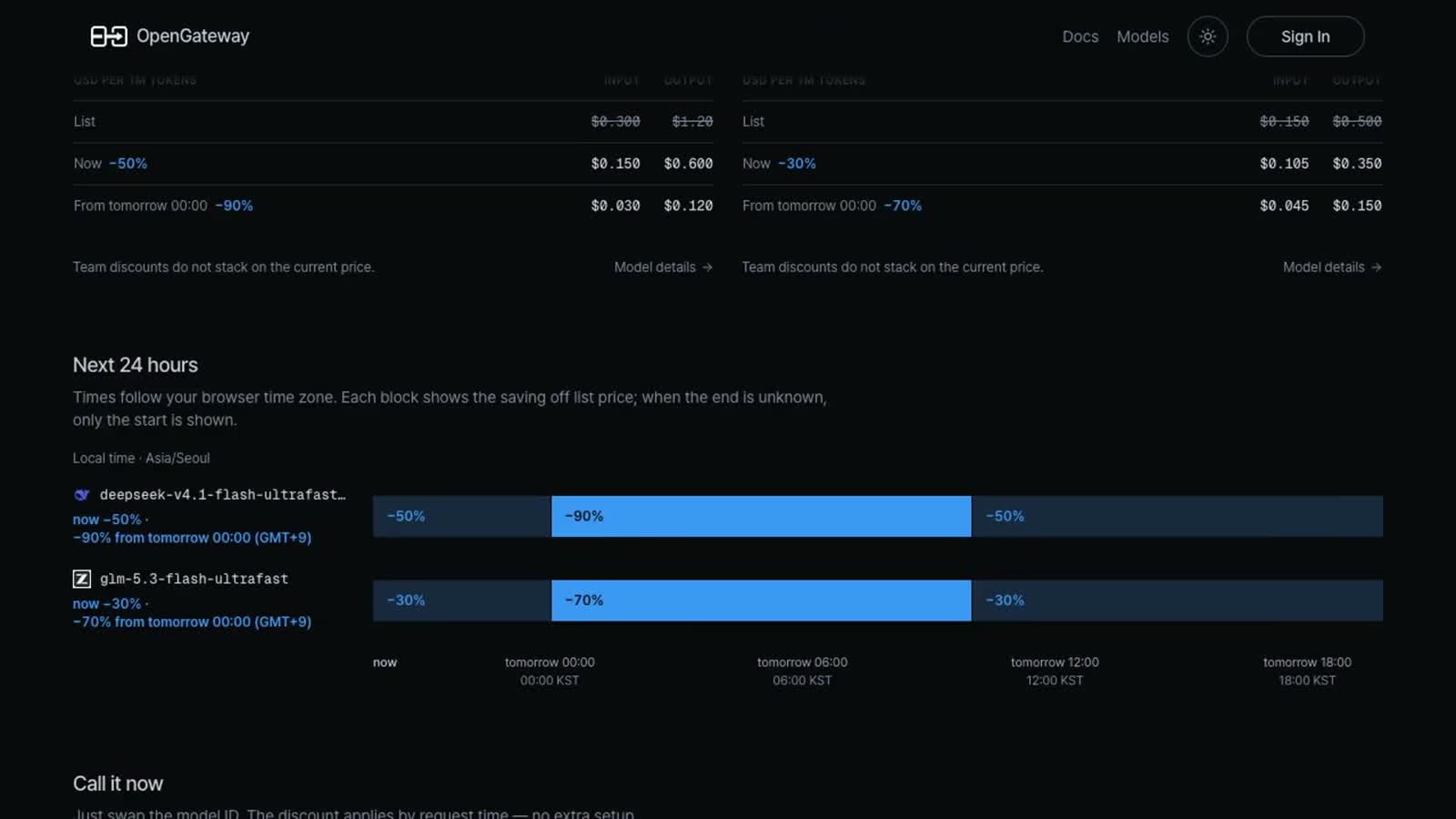
OpenGateway's ultrafast variant is on promotion until October 31 (promo page, checked October 22):
- List price: $0.30 input, $1.20 output per 1M tokens
- Weekdays 00:00–10:00 KST (GMT+9) and all day on October 24–25 and October 31 (Sat): 90% off → $0.03 input, $0.12 output
- Other times: 50% off at the time we checked
Promotions change, so check the page before relying on it — and remember this is the fast variant that skips reasoning.
On OpenRouter: pin the provider
By default OpenRouter picks a provider per request with a price-weighted probability, so you sometimes land on an expensive one. Appending :floor to the model name sorts by price, and account settings let you exclude providers (OpenRouter docs). In our runs, choosing the provider mattered more for cost than switching models.
Free options
- DeepSeek web and app chat: free and already on 1017. Note that in April 2025 South Korea's privacy regulator found the DeepSeek app had sent user prompts abroad without consent, so keep sensitive content out. (RFA)
- OpenCode free model: the coding tool OpenCode offers DeepSeek V4.1 Flash as a limited-time free model. Its docs do not state whether it is 1017, and limits are not published. (OpenCode Zen docs)
- Tencent WorkBuddy: free inside the desktop app until October 31; not available as an API. (WorkBuddy announcement)
4. A quick run with DeepSeek's own coding agent
DeepSeek also open-sourced DeepSeek Harness, a coding agent that edits files and runs commands, similar to Claude Code. Releases from October 17 support 1017; it is still a preview. (GitHub)
In the dsh 0.2.1-rc.2 web UI, with 1017 connected through OpenRouter, we asked in plain Korean (translated here):
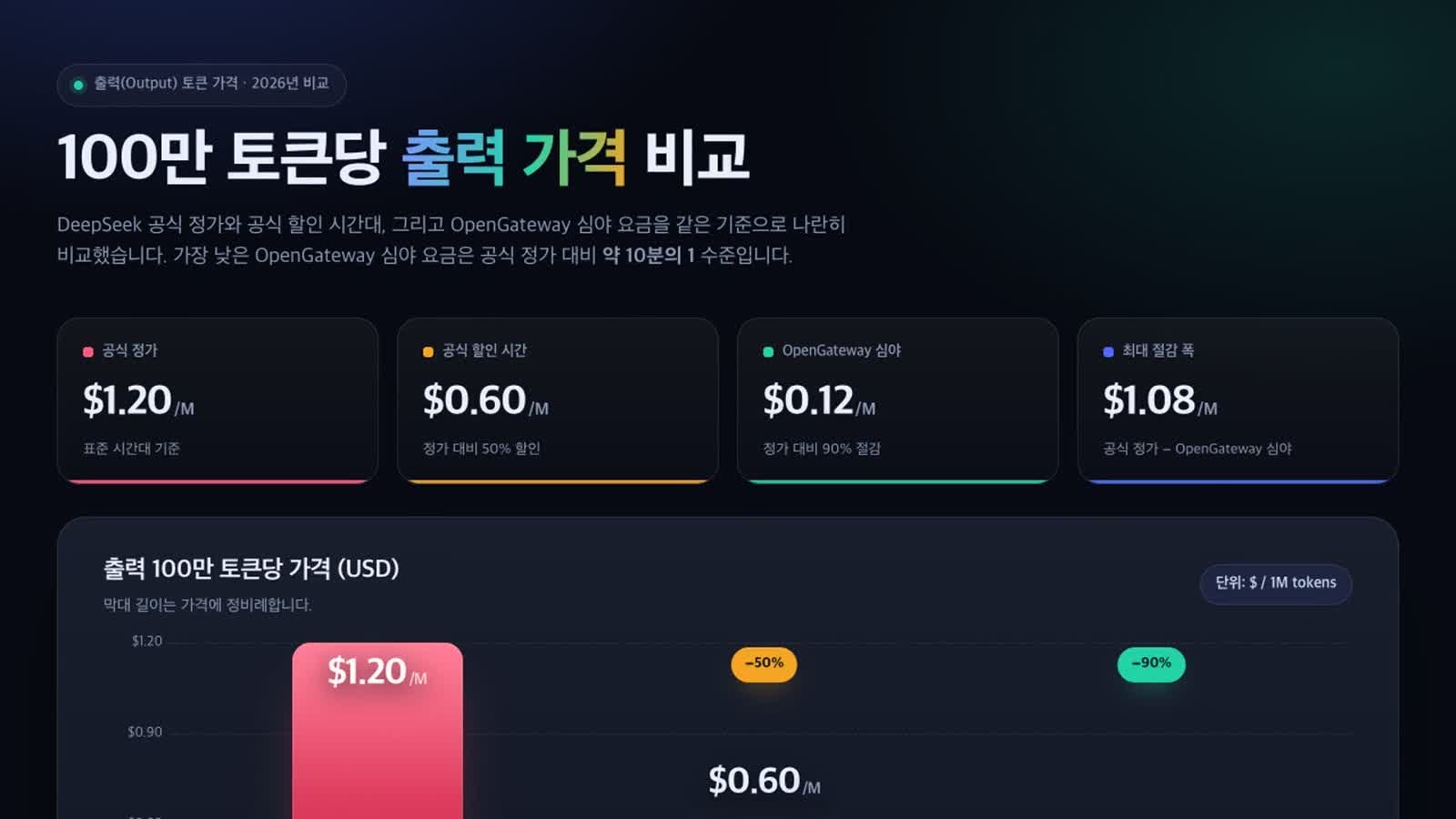
Make a DeepSeek price comparison page as a single index.html. Output per 1M tokens: official list
price $1.2, official discount hours $0.6, OpenGateway late night $0.12. Show it as a big bar chart.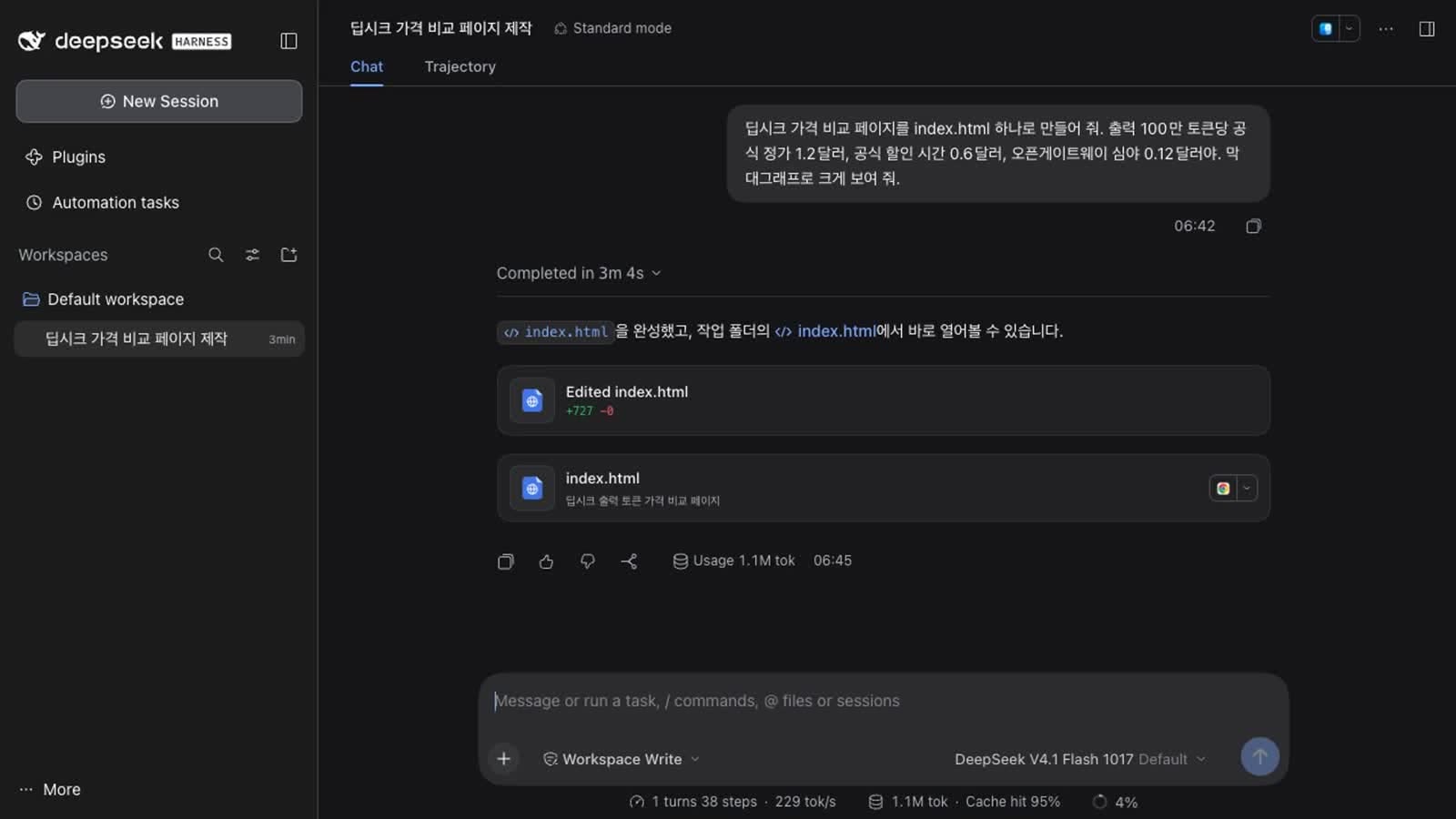
| Item | Value [Our measurement] |
|---|---|
| Time | 3 min 4 s |
| Steps (model calls) | 38 |
| Output | one index.html, 727 lines |
| Tokens | ~1.04M input (~0.99M of it cached) · ~13K output |
| Actual cost | $0.0185 (sum of OpenRouter per-call charges) |
Under two cents. Still, 38 steps for one simple page is a lot. The cost stayed low because most input was served from cache (a cheaper rate for content the model has already seen).
5. Our head-to-head with the previous version
We gave the previous V4.1 Flash and 1017 the same three jobs, all via OpenRouter, with costs taken from OpenRouter's actual charges. [Our measurement]
① Everyday browser tasks — both near perfect
We plugged each model into the browser agent we use daily, changing only the model name, and ran five tasks (building a table from the web, triaging GitHub issues, operating a to-do app, etc.) three times per model.
| Previous | 1017 | |
|---|---|---|
| Accuracy (207 points total) | 206 | 207 |
| Median time | 28 s | 39 s |
| Average output tokens | 3,959 | 3,127 (−21%) |
| Actual cost per run (OpenRouter default routing) | $0.0121 | $0.0062 |
No accuracy difference at this level. Shorter answers matched DeepSeek's claim. The cost gap came mostly from which provider each run hit: pinned to each model's cheapest provider, the previous version would actually have been cheaper (about $0.0015 vs $0.0027 per run).
② Making motion graphics — similar results, 1017 lighter in the process
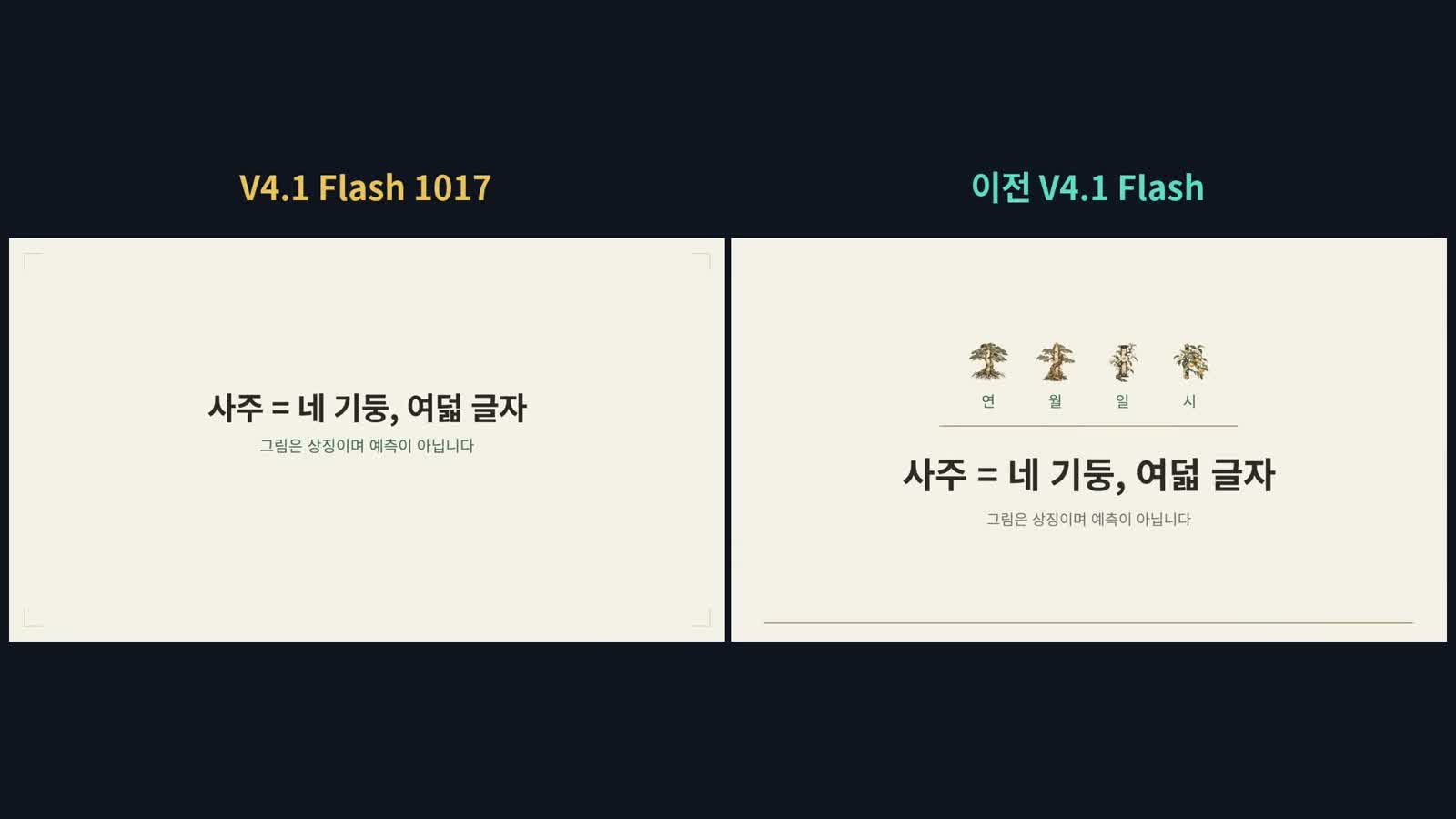
Using illustration assets we had prepared, we asked each model for a 20-second explainer (HTML motion graphics) on the basics of Korean four-pillars astrology, with two prompts (A and B). Quality was similar.
| Prompt | 1017 | Previous |
|---|---|---|
| A | 129 s · 51K tokens · $0.065 | 215 s · 68K tokens · $0.061 |
| B | 337 s · 64K tokens · $0.033 | 349 s · 116K tokens · $0.109 |
On B, 1017 used about half the tokens and a third of the cost; on A, cost was about the same. On another topic with a 48K output cap, the previous version twice spent ~47K tokens just thinking, hit the cap and produced nothing, while 1017 succeeded both times.
③ A maze-escape program — the previous version won this one
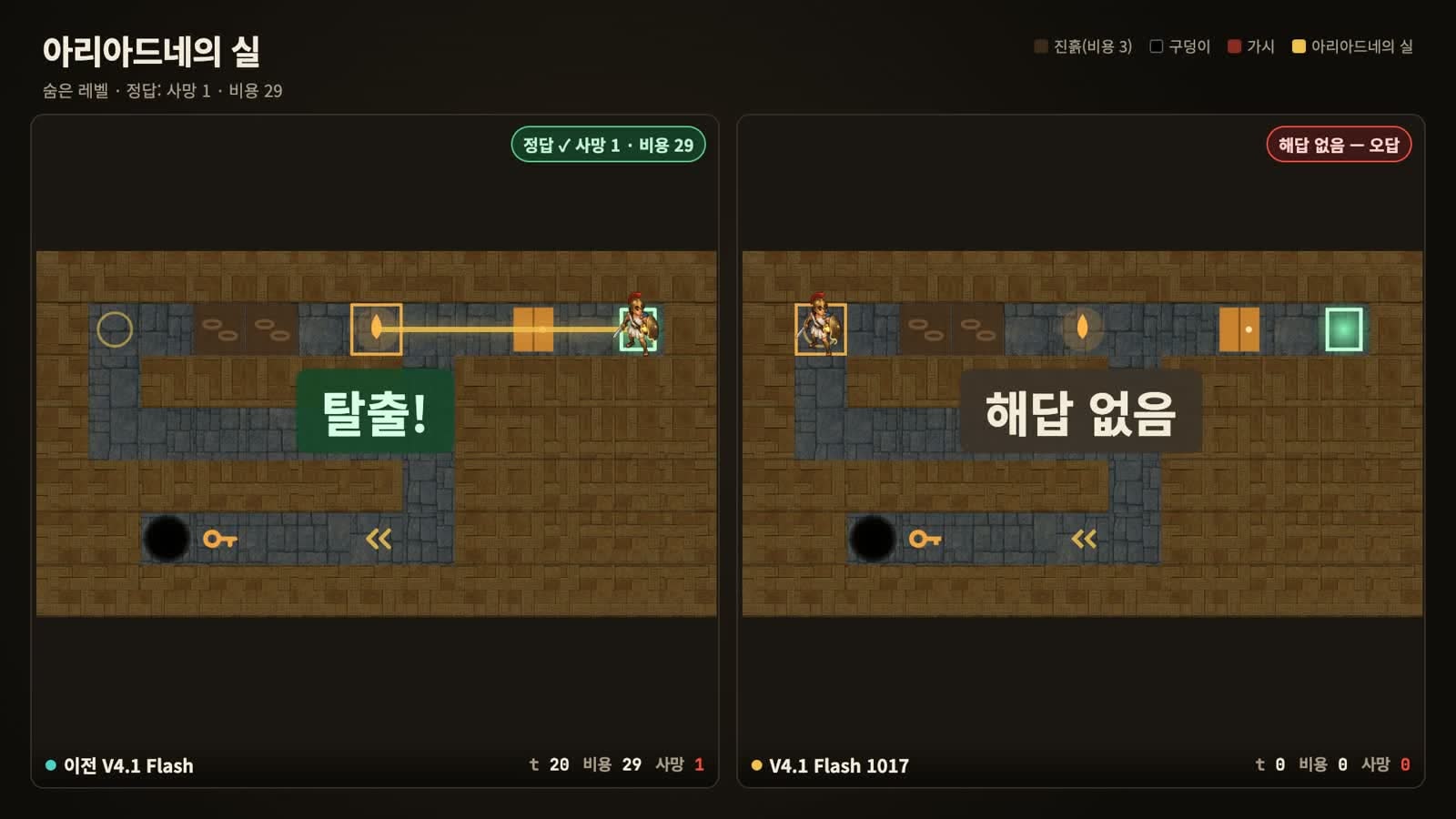
We gave only a rules document and asked for a program that finds the best escape path, graded on 23 hidden levels the model never saw. We used the Claude Code agent with only the model swapped via OpenRouter.
| Previous | 1017 | |
|---|---|---|
| Run 1 | 23/23 · 18 min | 22/23 · 24 min |
| Run 2 | 23/23 · 23 min | 22/23 · stopped at the 45-min limit |
| Actual cost, both runs | $0.29 | $0.58 |
Both 1017 misses were the same kind of level: one where you have to die once on purpose to get out. On this hard algorithmic task the previous version was more accurate at half the cost; 1017 held on longer and used roughly twice the tokens.
Summary
- On short jobs (browser tasks, motion graphics), 1017 gave shorter answers and was generally lighter.
- On the long, hard problem, the previous version did better in our test.
- Each task ran only two or three times, so treat this as a reference point. "1017 is better at everything" is not what we saw.
Three takeaways
- Batch big jobs at night or on weekends. DeepSeek's official API is half price off-peak, and OpenGateway is 90% off on weekday nights (KST) and selected weekend days until October 31.
- On OpenRouter, pin your provider and compare prices. The same model's cost swung 3–4x depending on provider. Check the quantization too.
- When an update ships, try it on two or three of your own tasks before switching. Vendor scores and independent measurements differ, and a new version can be worse for some jobs.
Because DeepSeek's files are public, you get to choose where and how to run the same model — and that choice changes the price and the speed.
Prices, promotions and provider lists in this post were checked on October 19–22, 2026 and may change. Our measurements ran each task only two or three times.